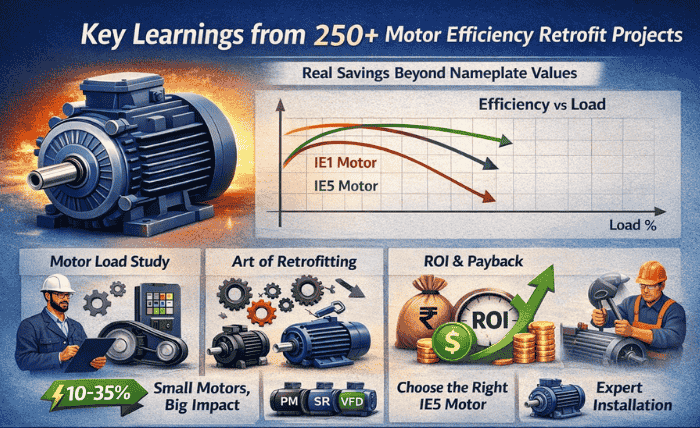
Why do industries often experience 10% to 35% real-world energy savings after upgrading to next-generation high-efficiency motors—even when the nameplate efficiency difference seems to be only 2% to 8%?
This question has driven our engineering team for years.
After completing 250+ retrofit and energy-efficiency implementation projects, here are the patterns, insights, and truths we discovered—the science and the art behind real, measurable savings.
1. Nameplate Efficiency ≠ Operating Efficiency (and the real difference is much bigger)
Most engineers look at the nameplate and assume the gain will be small.
But motors rarely operate at full load. At partial load conditions:
- Older IE1/IE2 motors drop efficiency sharply
- IE4/IE5 motors maintain a flatter, more stable efficiency curve
This gap at actual operating load—not the rated load—is where the hidden savings come from.
2. A Deep-Dive Motor Load Analysis Changes Everything
Before touching a single motor, we perform a detailed study because operating efficiency depends on:
- % loading (actual vs theoretical)
- Motor rewinding history
- Type of load (constant torque, variable torque, intermittent torque)
- Belt, pulley, gearbox or direct coupling
- Existing VFD installation and tuning
- Operating hours & tariff structure
- Start/stop pattern
- Application (pumps, blowers, compressors, conveyors, mixers, fans, etc.)
This is the “science” part of the process.
Without this analysis, every retrofit becomes guesswork.
3. Every Motor Can Be Converted Into An Annual INR/USD Value
After the load study, we convert each motor into a simple value:
“How much energy (₹ or $) this motor consumes per year”
and
“How much money can be saved with a higher-efficiency replacement.”
This helps industries prioritize the right motors first instead of replacing everything blindly.
4. The Artistic Side: Practical Engineering Judgements
Real retrofitting requires a lot of engineering intuition—something you can’t get from spreadsheets.
Three decisions especially require experience:
a) Predicting the true operating efficiency
Real-world motors behave differently from catalog values due to rewinding, misalignment, and voltage imbalance.
b) Converting belt drives to direct drives
This alone can boost efficiency by 3% to 12%, but only if the site conditions, layout, vibration tolerance, and shaft alignment allow.
c) Downsizing motors to increase loading
Industries often oversize motors by 20%–40% “just to be safe.”
Right-sizing the motor increases loading → which increases operating efficiency → which reduces energy cost.
This blend of logic + experience is what makes retrofitting more of an art.
5. ROI & Payback Periods Only Make Sense After Correct Prioritization
When companies use shortcuts (“replace everything with IE5 motors”), ROI becomes misleading.
But when motors are prioritized based on:
- Annual running hours
- Loading
- Application type
- Mechanical losses
- Tariff
- Feasibility
…then the resulting ROI and payback period become highly accurate.
Shortcuts don’t work.
A structured, data-backed approach does.
6. Interesting Trend: Small Motors Save More, But Cost More
In our projects, we noticed a pattern:
- Small motors show higher % savings
- Large motors show lower % savings
- But small motors cost more per kW, large motors cost less per kW
In the end, the economics balance out surprisingly well.
Most motor sizes deliver similar ROI when selected scientifically.
7. Not All IE5 Motors Are the Same—Choosing the Right One Matters
IE5 motors come with different:
- Technologies (Permanent Magnet, Synchronous Reluctance, Advanced Induction)
- Frequencies
- Frame sizes
- Starting torque characteristics
- Required drives (VFD or special controllers)
- Delivery timelines
- Duty cycles (S1, S2, S3…)
- Price/performance ratios
The motor must match the application—not just the efficiency rating.
8. On-Ground Installation Needs Skilled Hands
Even the best motor technology fails if the installation isn’t perfect.
Alignments, foundation leveling, balancing, load calibration, belt tensioning, and VFD tuning dramatically impact results.
This is where experienced shop-floor teams become essential.
9. Retrofitting is a Mix of Science, Engineering, and Art
After doing hundreds of projects, our conclusion is simple:
Energy-efficient motor retrofits start with science but succeed with craftsmanship.
You need:
- White-collar technical analysis
- Blue-collar on-site expertise
- A hybrid mindset to combine both
This is what delivers real, measurable energy savings—not just theoretical numbers.