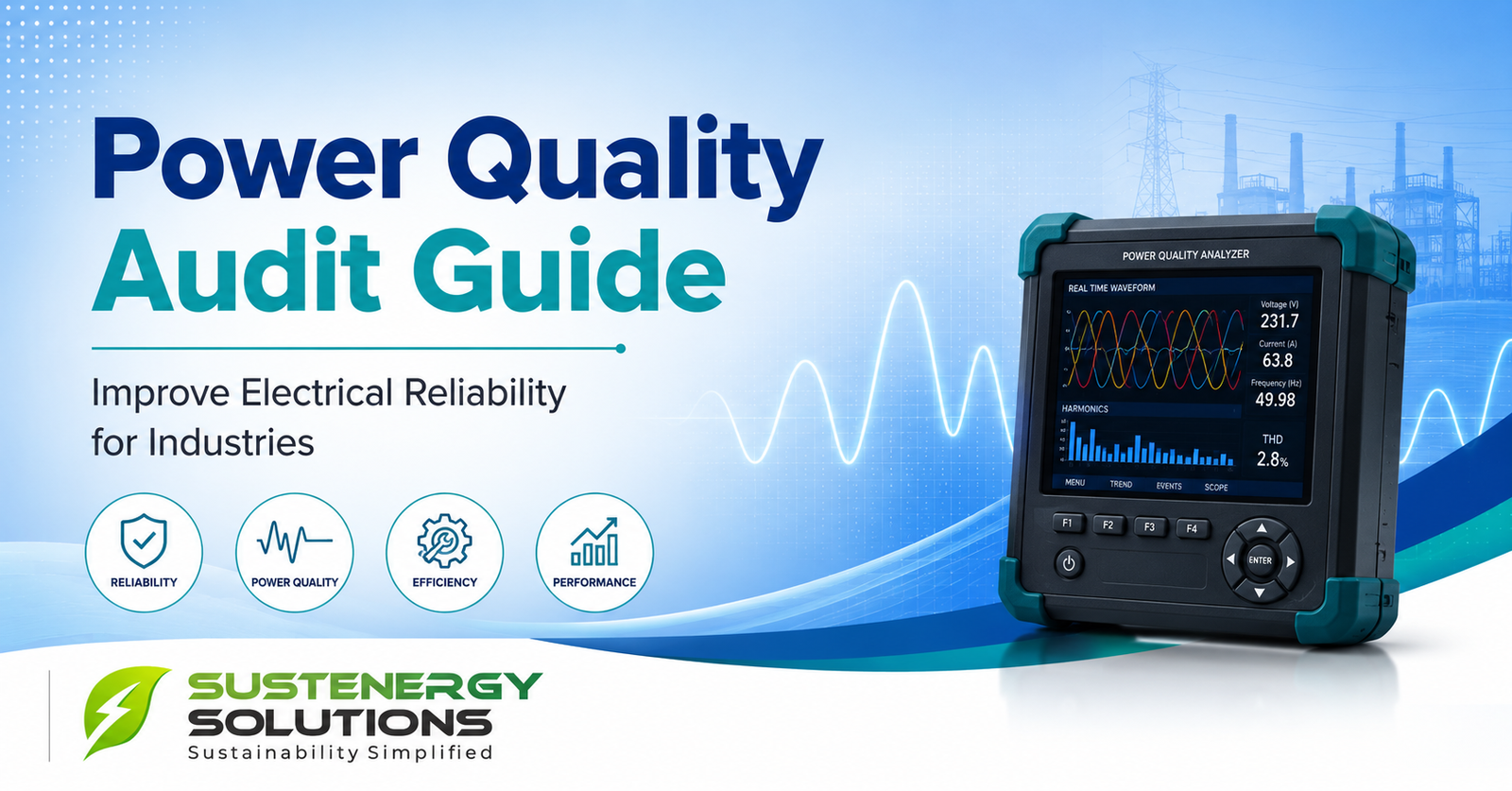
A Power Quality Audit Guide is essential for industries facing equipment failures, production losses, and rising electricity costs. Power quality issues such as voltage fluctuations, harmonics, and power factor problems can cause significant damage to electrical equipment and disrupt operations.
This Power Quality Audit Guide provides a comprehensive overview of power quality issues, their impact on industrial facilities, and how to identify and fix them. According to the Bureau of Energy Efficiency (BEE), power quality improvement is one of the most cost-effective ways to reduce energy costs and improve equipment reliability.
This Power Quality Audit Guide covers everything from understanding power quality parameters to implementing corrective measures with proven ROI.
What is Power Quality?
Power quality refers to the stability and cleanliness of electrical power supplied to equipment. Good power quality means voltage and current waveforms are stable, frequency is consistent, and there are no disturbances that could damage equipment.
Common power quality issues include:
Voltage sags and swells – Temporary drops or increases in voltage
Harmonics – Distortions in the electrical waveform
Power factor problems – Inefficient use of electrical power
Transients – Short-duration voltage spikes
Unbalance – Unequal voltage across three phases
This Power Quality Audit Guide helps facility managers understand these issues and their impact on operations.
Why Power Quality Matters for Indian Industries
According to energy audit reports, power quality issues are responsible for:
5-15% energy losses in industrial facilities
30-40% of equipment failures in manufacturing plants
Significant production downtime due to equipment tripping
Higher electricity bills due to poor power factor penalties
This Power Quality Audit Guide is essential for industries because:
1. Equipment Protection
Poor power quality damages sensitive electronic equipment, motors, and transformers. A power quality audit guide helps identify issues before they cause failures.
2. Energy Cost Reduction
Improving power factor and reducing harmonics can lower electricity bills by 5-10%. This Power Quality Audit Guide shows you how.
3. Regulatory Compliance
BEE and electricity boards impose penalties for poor power factor. A power quality audit guide helps maintain compliance.
4. Production Reliability
Power quality issues cause unexpected equipment tripping and production stoppages. This power quality audit guide helps prevent downtime.
Common Power Quality Issues
This Power Quality Audit Guide identifies the most common issues:
1. Harmonics
Harmonics are distortions in the electrical waveform caused by non-linear loads like VFDs, UPS systems, and LED lighting. Harmonics can overheat transformers, cause nuisance tripping, and damage sensitive equipment.
2. Power Factor
Power factor is the ratio of real power to apparent power. Low power factor means you’re paying for electricity you can’t use effectively. A power quality audit guide recommends power factor correction to reduce penalties.
3. Voltage Sags and Swells
Voltage sags are short-duration drops in voltage, often caused by starting large motors or faults in the system. Voltage swells are temporary increases in voltage. Both can damage equipment and cause production losses.
4. Transients
Transients are short-duration voltage spikes caused by lightning, switching operations, or faults. This power quality audit guide explains how to protect against transients.
The Power Quality Audit Process
This Power Quality Audit Guide follows a proven methodology:
Step 1: Data Collection
Gather electrical bills, equipment specifications, and historical data. This power quality audit guide recommends collecting 12-24 months of data.
Step 2: Site Assessment
Conduct on-site measurements using power quality analyzers. This includes measuring voltage, current, power factor, harmonics, and transients.
Step 3: Analysis
Analyze data to identify issues and their root causes. This power quality audit guide uses industry standards for comparison.
Step 4: Recommendations
Provide prioritized recommendations with cost estimates and ROI calculations. This power quality audit guide categorizes measures as low-cost, medium-cost, and high-cost.
Step 5: Implementation Support
Assist in implementing corrective measures and verify results.
Benefits of Power Quality Improvement
This Power Quality Audit Guide identifies the following benefits:
5-15% energy savings through power factor improvement
Reduced equipment failures and extended equipment life
Lower electricity bills through penalty avoidance
Improved production reliability and reduced downtime
Regulatory compliance with BEE and electricity board standards
Why Sustenergy Solutions?
Sustenergy Solutions is a BEE Certified energy audit firm providing comprehensive power quality audit services across India. Our team has 20+ years of experience and includes BEE Certified Energy Auditors (EA-29833).
Our Credentials:
BEE Certified Energy Auditors
CMVP Certified Professionals
20+ Years of Experience
PAN India Service Coverage
Our Services Include:
Power quality audits
Harmonic analysis and mitigation
Power factor correction
Electrical network studies
Thermal imaging
Measurement & Verification (M&V)
Conclusion
Power quality issues can cost Indian industries millions in energy waste, equipment damage, and production losses. This Power Quality Audit Guide provides a roadmap to identify and fix these issues.
If you are looking for professional power quality audit services, connect with Sustenergy Solutions today.
 Gurugram, Haryana
 +91 95998 25696
 www.ssggn.com